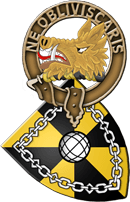
President, Clan Campbell Society of Australia, Editor, Cruachan, Journal of the Clan Campbell Society of Australia, President, CCS President of the New South Wales Branch, Personal Representative of Mac Cailein Mòr to the Scottish Australian Heritage Council
A Life Among Campbells
Memoirs of Barbara Gurney
Edited by: C. Randell Seale, OBM
When people ask how I became interested in Clan Campbell history and genealogy, I usually tell them that I never really had a choice. I was born into it.
I grew up on a farm called Argyll near an old gold-mining town in central New South Wales. Ours was an extended Campbell family. My Campbell grandparents lived with us, as did my widowed mother. My uncle, also widowed, owned the farm. We grew wheat and ran Merino sheep, and like many country families of the time we were largely self-sufficient, growing our own fruit and vegetables and keeping chickens for eggs.
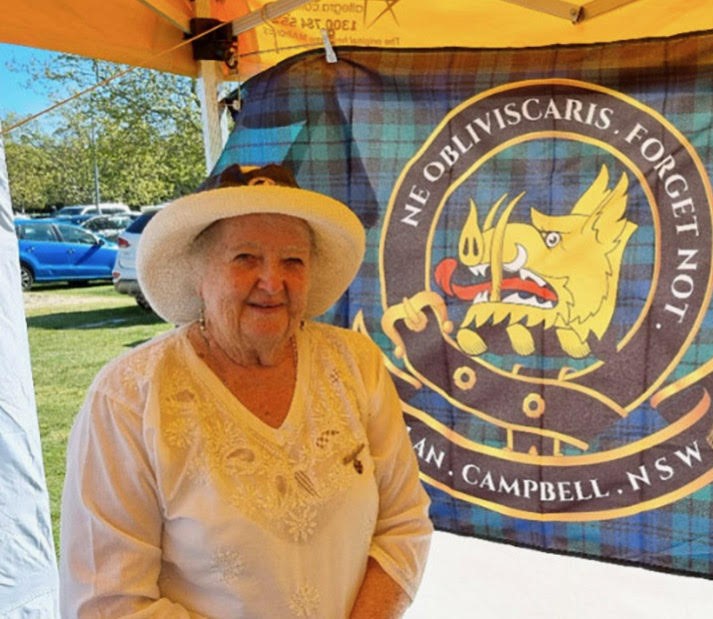
Scottish influences were everywhere. Many of the surrounding farms had names such as Annandale, and Glenleigh. In the evenings, entertainment often consisted of gathering around the piano and singing favourite Scottish songs. Our early lighting came from kerosene and Aladdin lamps until my uncle bought a 220-volt generator when I was about ten years old. To me, that felt very modern indeed.
My mother's family was entirely Scottish, Irish, and Scandinavian. My grandmother's maiden name was Watt. Her ancestors came from Banffshire before becoming East Indian merchants in Copenhagen and Singapore and eventually settling in Australia.
My father, Denis Gurney, was English. He came to Australia at the age of fifteen to help an uncle who had received a farm as a soldier settler after the First World War. In 1940 he enlisted in the Royal Australian Air Force, trained in Canada, and served in Bomber Command in England as a Wireless Operator and Air Gunner in Lancaster bombers.
He returned to Australia in 1944 and remained with the RAAF until he was posted to New Guinea in 1945. Three weeks later, while on a night submarine patrol, his aircraft disappeared. Nothing was ever found. Like many wartime families, ours was left with unanswered questions and an empty place that could never truly be filled.
My education began through correspondence lessons, which I completed for three years while living on the farm. I then attended the local central school before being sent to board at Presbyterian Ladies' College in Sydney. When I was fifteen, my mother, grandmother, and I moved permanently to Sydney, where we lived with a maiden Campbell aunt. I completed my schooling at Cheltenham Girls High School.
Art had always interested me, so I enrolled at the National Art School, studying illustration for four years full-time. Later I completed a ceramics course and found employment as an illustrator at the Correspondence School in Sydney. Eventually I also obtained a teaching certificate through the University of Wollongong.
It was in the late 1960s, after marrying Dutch-born Pieter Buining, that my interest in genealogy really began to take shape. This was long before the internet and online databases. Research meant writing letters, telephoning elderly relatives, searching through library records, and spending hours in archives.
I haunted Sydney's Mitchell Library and searched genealogical records through the Mormon Church. Every small discovery seemed to lead to another question. Before long I found myself drawn deeper and deeper into family history.
In 1972 I travelled overseas for the first time. I crossed the Pacific and toured America and Canada by Greyhound bus, seeing far more of the world than I had ever imagined possible while growing up on a sheep farm in New South Wales. I spent the winter working in London and then, in 1973, made my first journey into Scotland.
I can still remember it vividly.
I had researched my family for years and read countless records, but nothing prepared me for actually arriving in Argyllshire. I often describe the feeling as gooseflesh. It was as though the landscape itself felt familiar.
During that trip I visited every area I could identify with family connections. I also spent time conducting research in Edinburgh and Glasgow, working through records at the National Archives and the Mitchell Library. I returned to Australia in 1974 by way of East Africa, carrying with me a renewed determination to continue my research.
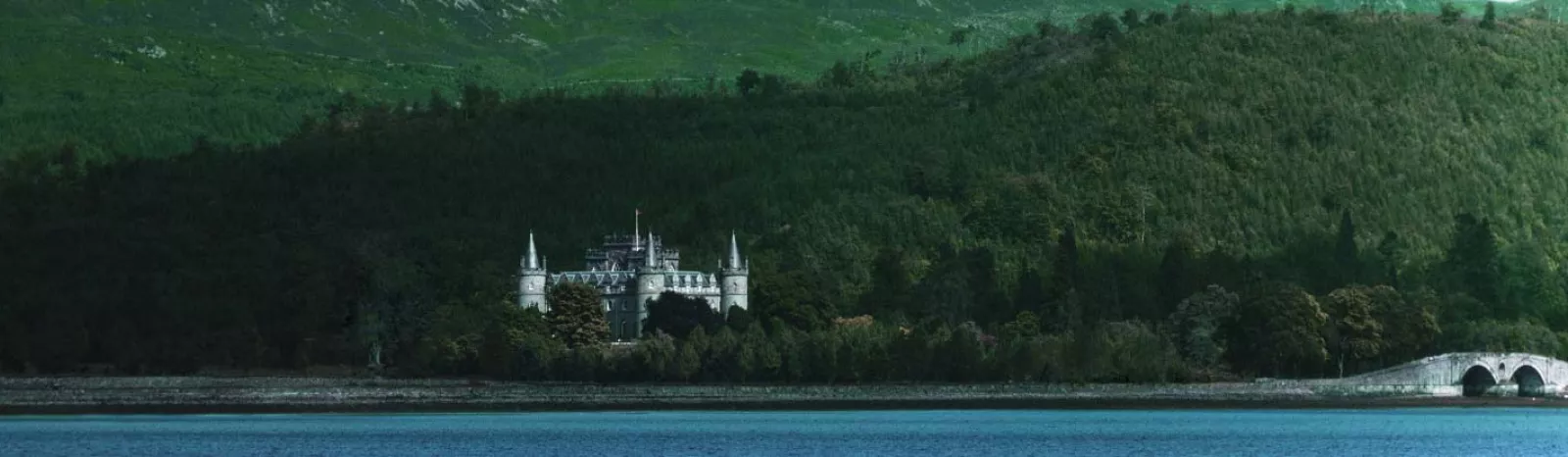
Around that same time, members of my family joined others in sending donations to Inveraray following the fire at Inveraray Castle. Although we lived on the other side of the world, there was still a sense that what affected Inveraray somehow affected us.
My family's Campbell connection is believed to come through the Craignish Campbells. While modern DNA testing has not yet provided the evidence I once hoped it would, our family still possesses remarkable heirlooms. Among them is a Gaelic Bible inscribed "EOIN CAIMBEUL of Craignish 1784" and an eighteenth-century Andrea Ferrara sword bearing the Craignish motto. Early family homes in Australia were named Scarba and Craignish, reminders that the connection remained important to generations who had left Scotland behind.
One ancestor who particularly fascinated me was my great-great-grandfather, John Archibald Campbell, a surgeon in Sydney during the 1830s. His son, also named John Archibald Campbell, apprenticed in his father's druggist business but eventually married an Irish orphan, Eliza Geoghegan, and followed the lure of the Australian goldfields. Their story linked our family directly to some of the great movements that shaped colonial Australia.
By the late 1970s I found another way to combine my interests in history, genealogy, and art.
In 1977 I became involved in the revival of the Clan Campbell Society in Sydney and helped produce the first issue of Cruachan. In those days publishing was very different. Layout involved scissors, glue, artwork boards, and endless patience. Although I formally became editor in 1983, I had been illustrating and preparing pages from the beginning.
That same year I attended the World Gathering of the Campbells at Inveraray. It was a memorable experience and provided opportunities to meet Craignish descendants and copy family records that would otherwise have remained inaccessible.
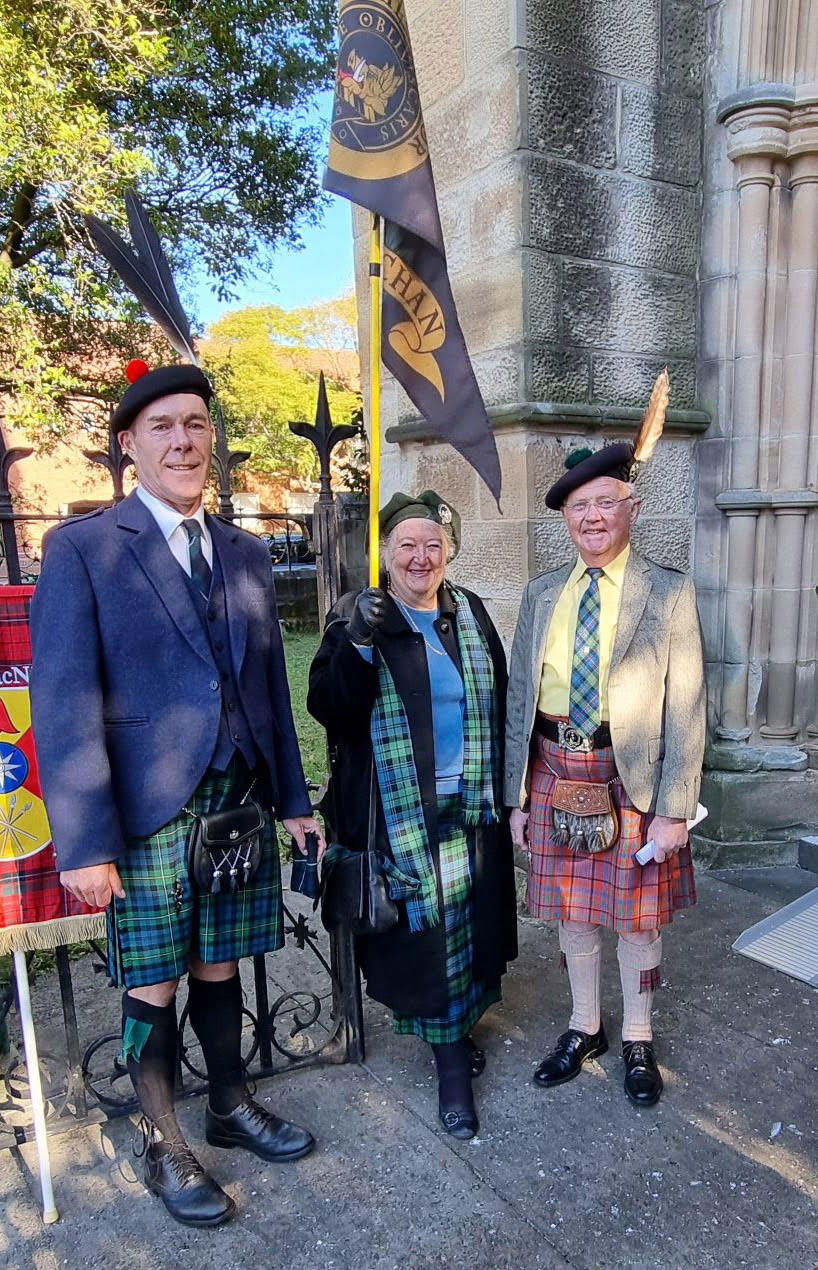
Over the years I became acquainted with many people who have contributed greatly to Campbell history and genealogy. One of the most important was Diarmid Campbell, whom I first came to know through correspondence in the 1980s while he was editor of the Clan Campbell journal. Diarmid encouraged me to write my own Campbell family history, Campbell Connections, which I eventually published in 1993.
Through him I met Dr. Lorne Campbell and the late Alastair Campbell of Airds and his wife Mary Ann. The Airds became valued friends after their visits to Australia, and I later enjoyed staying with them in Taynuilt. Friendships such as these enriched my understanding of Campbell history immeasurably.
My involvement with the Scottish Australian Heritage Council provided another avenue for service. I became the Council's genealogist, designed its logo, and produced the annual Scottish Week Souvenir Program from 2009 until 2019.
In 1988 I helped organize clan events during the visit of the Duke and Duchess of Argyll to Sydney as part of Australia's Bicentenary celebrations. Those events remain among my fondest memories of clan activity.
Research continued to take me back to Britain and Europe repeatedly. I traveled in 2000, 2009, 2012, 2014, and 2019, combining family history research with visits to places connected with Campbell history. In 2009 I attended both the Homecoming celebrations in Edinburgh and the Inveraray Games.
My service to the Clan Campbell Society also continued. After many years on the committee, I was elected President of the Clan Campbell Society in Australia and President of the New South Wales Branch in 2009. I continue to serve in both roles today. I was also appointed to represent Mac Cailein Mòr at Scottish heritage events and to carry his pinsel (generally a 2ft x 4ft version of the Duke's Standard - CRS) on ceremonial occasions.
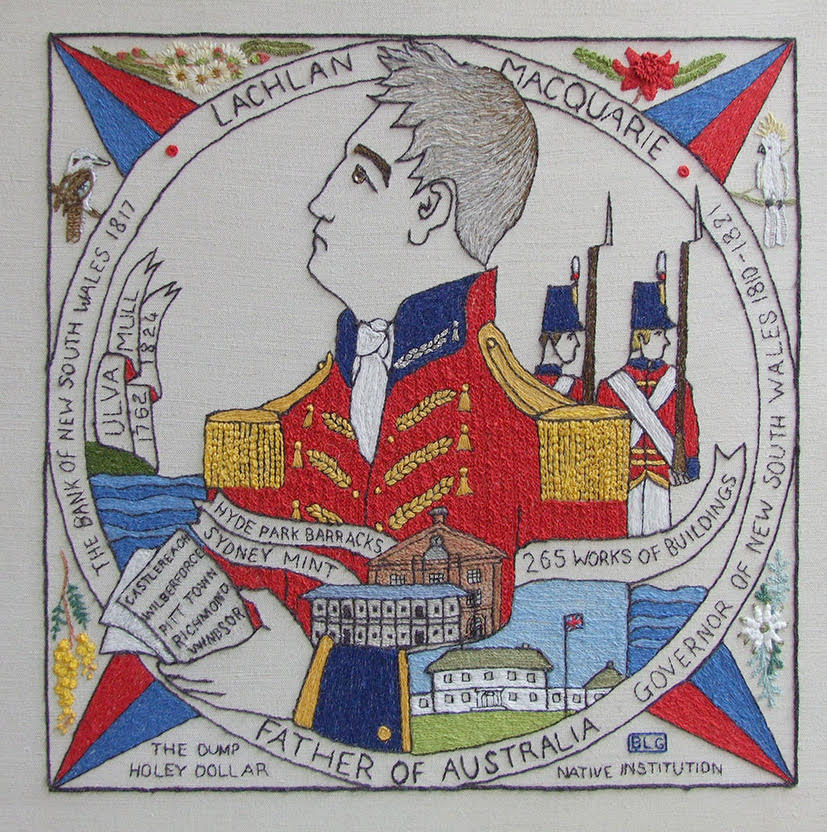
In 2009, I stitched a panel for the Scottish Diaspora Tapestry. My panel depicted our early Australian Governor Lachlan Macquarie, who was from Ulva, and whose second wife was Elizabeth Campbell of Airds.
Like many people of my generation, I also found myself adapting to rapidly changing technology. Many years ago, we were handed Macintosh computers at work and simply told to teach ourselves. So we did.
Most of my computer skills have been self-taught. I designed the Clan Campbell Society of Australia's website using Adobe Dreamweaver and helped establish and manage the Society's Facebook presence. When I look at some of the sophisticated websites now being produced around the world, I remain rather in awe of them.
Throughout my professional life I continued to use my maiden name for freelance artwork and illustration and later reverted to it permanently. Campbell has always felt like an important part of who I am.
Looking back, it is remarkable to think how much of my life has revolved around a curiosity that began in childhood. What started as stories told around a piano on a farm called Argyll eventually led to archives in Edinburgh, libraries in Glasgow, gatherings at Inveraray, friendships across Scotland, Australia, and North America, and decades of service to Clan Campbell organizations.
I have one son, now a computer engineer, and three grandsons who are still at school. I hope that they, too, will understand that family history is about more than names and dates. It is about people, places, memories, and connections.
My own journey has shown me that heritage is never really lost. Sometimes it simply waits patiently to be rediscovered.