Chief of Clan Campbell
THE 13TH DUKE OF ARGYLL ~ In Gaelic, the chief of the Clan Campbell is known as "Mac Cailein Mór" meaning "Son of Colin the Great", called from his ancestor Sir Colin Campbell, Knight of Lochawe, who was killed in battle in 1294.
(Pronunciation: Maa HI len more)
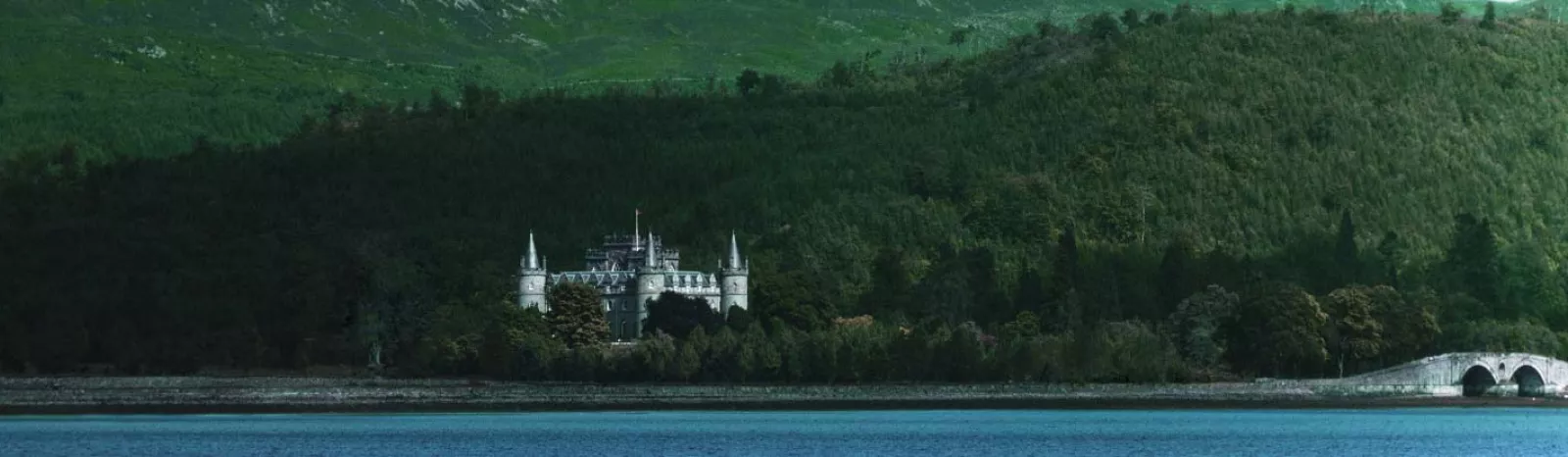
Chief's Seat - Ancestral Home of the Duke of Argyll
Inveraray Castle, Inveraray, Argyll, Scotland
(Pronunciation: inver AIR y, ArGYLL)
Chief's Motto
"Ne Obliviscaris" - Latin for "Do Not Forget"
(Pronuciation : NAY ob lee vis KAR iss)
Clan Campbell Plant
Bog Mirtle, or sometimes Fir Club Moss.
Clan Slogon or Clan War Cry
"CRUACHAN!"
"The Campbell war cry is Cruachan! and this refers not, however, as has long been assumed, to the mountain which dominates Loch Awe and much of Argyll besided but to the farm of the same name on the west bank of Loch Awe directly opposite Innischonnell Castle. This is an obvious place for a rallying point. The slogan is also used by the Argyll and Sutherland Highlanders (Regiment)." ~ Alastair Lorne Campbell of Airds, Unicorn Pursuivant, A History of Clan Campbell, Volume 2, From Flodden to the Restoration (Edinburgh: Edinburgh University Press, 2002), page 290.
(Pronunciation: CROO a han/CROO a h ' n)
Clan March
"The Campbells Are Coming!" Also known under a variety of names including, in the Gaelic "Baile Inneraora", " The Town of Inveraray". Read More.
Clan Tartan
There are four patterns of tartan authorized by Mac Calein Mór. Campbells of Breadalbane, or Campbells of Cawdor, or Campbells of Loudoun, may wear their respective tartans, but all Campbells may wear the blue, green and black Campbell sett. Often sold as "Ancient Campbell" or "Campbell Ancient" or simply "Clan Campbell". Offically known in tartan registeries as "Tartan #1".
The sett known as "Campbell of Argyll" is NOT authorized by the Chief of Clan Campbell and members of Clan Campbell are strongly urged not to buy or wear "Campbell of Argyll" setts.
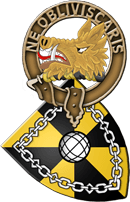
Clan Crest / Clanmans' Badge
The Chiefs full heraldic achievement includes, as Crest on his helmet, "a boars head, erased" or torn from its shoulders. This boar's head, on the wreath of twisted threads that bound the 'Mantling' or cloth protection to the back fo the helmet against the sun, may be worn by Clansmen and Followers of Mac Cailein Mór within a buckled strap on which is displayed the chief's motto "Ne Obliviscaris".
Origin of the Campbell Name
It was Sir Cailean Mòr Campbell's grandfather Dugald on Lochawe who is said to have been the first given the nickname "Cam Beul" since he apparently had the engaging trait of talking out of one side of his mouth. Cam beul means "Curved Mouth" (or Wry-Mouth) in the Gaelic. This Dugald was so much loved by his family that they took his nickname as their family name and held to it even beyond Argyll.
The spelling of the surname (family name) was originally Cambel. Then when Robert the Bruce's son King David came to the throne as King of Scots he brought with him a number of Norman knights to whom he gave lands in an attempt to introduce Norman efficiency in administration. David had been at the English court and admired the Norman system of feudalism. The use of the spelling "Campbell" may perhaps have been as a result of Norman rather than Gaelic scribes attempting to write the Gaelic name.
The name Cambel was first used by the family in the 13th century. The first chief of the clan to appear on record as "Campbell" may well have been Sir Duncan of Lochawe when he was created Lord Campbell in 1445.
In November 2006, C. Randell Seale of the Clan Campbell Society (NA) proposed a new theory that the "Campbell" name had a medical origin. In part, he noted that Einar Sigurdsson, Earl of Orkney (died 1020), was called Einar Wry-Mouth as was Bolesław III Wrymouth, Duke of Lesser Poland, Silesia and Sandomierz between 1102 and 1107 and over the whole Poland between 1107 and 1138. Surviving artwork of Einar of Orkney and Boleslaw of Poland indicate a similar facial curvature even though the two men are not directly related. The modern medical explanation for this facial curvature is a form of Torticollis (from the Latin torti, meaning twisted, and collis, meaning neck), or "wry neck". A condition in which the head is tilted toward one side (cervical rotation), and the chin (mouth) is elevated and turned toward the opposite side (cervical extension) thereby producing a "Cam beul" or curved mouth in some cases. "This explanation of naming Dugald as 'Wry Mouth' or 'Cam Beul' after his physical characteristic of a 'crooked mouth' is absolutely consistent with the Scottish Gaelic naming tradition of the time period; such as the Clan Cameron progenitor being named 'Cameron' for his 'crooked nose', or someone being named 'The Red' or 'The Fair' after their hair color or good looks." Seale explained.
Highland Customs
- Sometimes there is a difference between official language and common usage. To the Lord Lyon a Chief may be chief of the Name or Family or House. To his clan the Chief is chief of the clan.
- In some clans those bearing heraldic arms who were the heads of families who long held lands from the Chief, often as his acknowledged kin, are considered Chieftains. In Clan Campbell while some were called Chieftains in government documents, the situation was never made formal by the Chief and the term is not currently used.
- The chiefly kin are those of proven descent from the Chief, but this again is only of genealogical and not of organizational significance in Clan Campbell.
- Most often the heads of the houses of the chiefly kin and other prominent members of the Clan are denoted by being given their territorial designation, whether the lands of the name are still owned by the family or not. Examples today would be Alastair Campbell of Airds and Alan Campbell of Inverawe. Territorial designations may be recognized or given by Lord Lyon King of Arms (Chief Heraldic Officer for Her Majesty in Scotland), where appropriate, on a grant or matriculation of arms.
- Territorial designations in Scotland, when made official by the granting of such recognition, become legal surnames. In that sense the `of' is similar to the French `de', Alan Campbell of Glenfeochan being the equivalent in that sense of Couve de Murville, for example. This means that any "Esq." or "Bt." should be placed after the territorial designation, as in "Sir Ilay Campbell of Succoth, Bt."
- In order to preserve the integrity of such designations, where a family no longer owns the lands of their territorial designation, the Lord Lyon will seldom allow a new owner to use the designation. Modern owners are expected to use `the intrusive comma', as in `Charles Struthers, Ardmaddy' where, although Mr. Struthers owns Ardmaddy, he has not received official recognition from Lyon.
- When the county of Argyll was full of Campbells whose fathers mostly had the names Colin, Neill, Duncan, Dugald, James, John or Archibald, those who moved about on the business of the county often found it helpful to refer to or identify a man not by his name but by the name of his place. Alastair Campbell of Airds, former Chief Executive of Clan Campbell, could be refered to as `Airds', or Alan Campbell of Inverawe as `Inverawe'. While this is somewhat archaic, the practice still has a certain value.
- In order to differentiate between a landowner and a tenant in the Highlands, the custom arose of calling the owner, for example, `Donald Campbell of Airds' and of calling the tenant `John Campbell in Airds'. This has proven to be very useful for genealogists and historians researching the history of families or the lives of individuals. Whimsically it means that in a clan context (or publication) `Sigismund McGutteral of Minneapolis' would more likely be described as `from' or `at' Minneapolis in order to avoid the inference that he owned the city.
- In the 18th century and earlier, the wife of a laird or chieftain who today would be called `Mrs. Campbell' was often mentioned, even in legal documents as `the lady Airds' or `the lady Inverawe' (note the small "L" for lady). This, however, is now considered to be archaic.
- The eldest daughter of a Laird or Chieftain, if she did not marry, could continue to call herself `Miss Campbell of ...', whereas her younger sister was merely Miss Campbell.